SEAI EWI Inspection Checklist and Common Fails
Receiving an SEAI audit notice or post works inspection rejection delays contractor cash flow and risks formal scheme disciplinary points. Because SEAI inspectors frequently arrive after scaffolding is struck and final render coats are cured, any visual discrepancy at sills, vents, or base tracks immediately prompts demands for concealed stage evidence.
Understanding the exact checklist items SEAI quality auditors target enables contractors to catch defects internally before submitting the Declaration of Works.
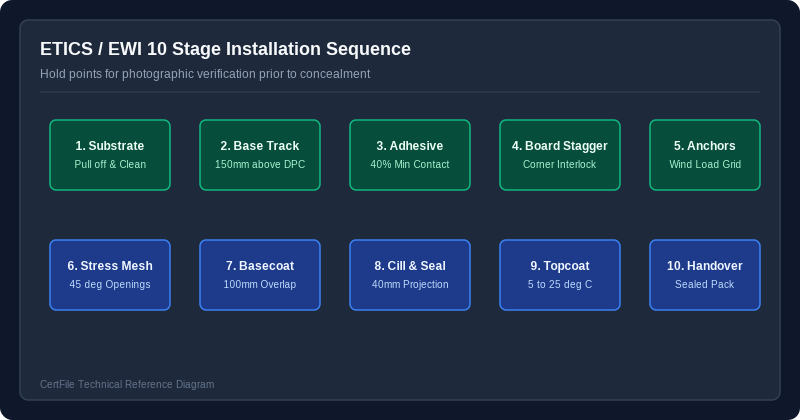
Step by Step Site Execution Sequence
- 1
Verify Contractor and System Registration
Confirm active SEAI registered contractor status for the External Wall Insulation measure code and verify the installed system holds a valid NSAI Agrément certificate.
- 2
Inspect Ventilation and Combustion Air Continuity
Check that all existing background wall vents, sub floor air bricks, and boiler flue clearances are cleanly sleeved through the insulation layer without blockage or thermal bypass.
- 3
Verify Reveal Returns and Window Sill Projection
Confirm window reveals carry minimum specified insulation thickness overlapping frames, and aluminium oversills project minimum 40 millimetres past finished render with sealed stop ends.
- 4
Check Starter Track Clearance and Plinth Continuity
Inspect finished plinth lines confirming appropriate clearance above ground level and DPC without open gaps underneath the drip profile.
- 5
Audit Concealed Photographic Evidence Folder
Review geotagged stage photographs proving substrate pull off testing, 40 percent adhesive contact, staggered corner boards, mechanical fixing density, and 100mm mesh overlaps.
- 6
Verify Homeowner Maintenance Pack and Declaration of Works
Confirm the homeowner received their copy of the signed SEAI Declaration of Works and the NSAI Agrément system maintenance manual.
What to Record on Site
CertFile and the installer build the technical file together. Capture these mandatory evidence items before subsequent layers conceal the work.
Required Photos
- Unobstructed wall vents and extended duct sleeves before and after render
- Ruler verification of window reveal insulation and oversill overhang projection
- Starter track clearance above ground and finished DPC line
- Concealed adhesive pattern, board stagger, and mechanical anchor grids
- Completed property elevations matching SEAI grant application MPRN address
Readings and Logs
- Net insulated wall area (m2) and target U value (0.27 W/m2K or better per DTSS [CONFIRM])
- System NSAI Agrément certificate number and insulation thickness
- Pull off test tensile values and operative installer registration ID
Operative Sign Offs
- Signed SEAI Declaration of Works by approved contractor
- Homeowner acknowledgement of handover maintenance manual
Top 5 Common SEAI EWI Audit Failures
First, obstructed or omitted ventilation sleeves: covering over sub floor air bricks or failing to sleeve passive wall vents creates critical indoor air quality and damp hazards, triggering immediate audit failure. Second, inadequate sill projection or missing end caps causing water staining down newly rendered walls.
Third, uninsulated window reveals leaving exposed cold masonry around window frames. Fourth, misaligned starter tracks sitting below ground gravel or bridging the DPC. Fifth, incomplete photographic proof when asked to verify concealed anchor patterns or adhesive spread under desktop audits.
Quality management under NSAI Agrément surveillance audits requires that every concealed stage of an External Thermal Insulation Composite System (ETICS) is documented prior to coverage. Under EAD 040083-00-0404 and BS EN 13499 or BS EN 13500 frameworks, system durability depends directly on verified substrate readiness, continuous adhesive contact, accurate mechanical anchoring, and watertight perimeter detailing. Site supervisors should never authorise basecoat or render application until photographic hold points have been reviewed and signed off by the lead applicator.
Across Irish and UK retrofit programmes, including SEAI Domestic Technical Standards and Specifications (DTSS) and PAS 2030/2035 frameworks, retrospective inspection cannot verify hidden layers such as starter rail seals, adhesive dab percentages, or anchor embedment depths. Recording geolocated and time stamped evidence as work progresses creates an indisputable technical audit trail that protects the installer against unmerited warranty callbacks and audit rejections.
Site Supervision, Compliance Verification, and Long Term Warranty Protection
Delivering consistent quality across External Thermal Insulation Composite System (ETICS) contracts requires disciplined site supervision at every critical hold point. Under the NSAI Agrément surveillance scheme and the SEAI Domestic Technical Standards and Specifications (DTSS), contractors carry direct responsibility for proving that concealed components were installed strictly in accordance with the system holder technical manual and published certificate limits. Verbal assurances or unindexed smartphone photos are insufficient when resolving post completion disputes or passing independent technical audits.
Every project site should operate a clear inspection protocol led by a competent site supervisor or lead applicator. Before progressing from substrate preparation to base rail installation, from board fixing to mechanical anchoring, or from basecoat reinforcement to decorative topcoat, the supervisor must inspect the completed work against manufacturer tolerances and record verifiable evidence. Recording batch numbers from adhesive bags, basecoat drums, mesh rolls, and finish buckets ensures complete product traceability back to the approved distributor.
In addition to photographic documentation, contractors should maintain daily environmental logs noting ambient air temperature, wall surface temperature, and relative humidity at application time. Cementitious adhesives and polymer modified renders cure predictably only within specified climatic windows, typically between 5 degrees Celsius and 25 degrees Celsius per manufacturer data sheets. Documenting weather compliance protects the installer if sudden overnight frost or unexpected wind driven rain affects uncured finishes.
Finally, compiling all stage photographs, pull off test records, operative digital sign offs, and maintenance instructions into a structured, tamper evident handover pack gives both the building owner and the installer permanent peace of mind. A transparent ten year audit folder demonstrates professional craftsmanship, accelerates grant payment drawdowns, and protects your contracting business against unmerited warranty claims.
Regulatory Audit Trail and Handover Evidence Standards
Across both Ireland and the United Kingdom, external wall insulation and insulated concrete formwork contractors operate under strict third party inspection frameworks. In Ireland, NSAI Agrément ETICS schemes and SEAI Domestic Technical Standards and Specifications (DTSS) require registered contractors to retain project specific technical dossiers for ten years following completion. In the UK, PAS 2030, PAS 2035, and TrustMark lodgement frameworks impose equally rigorous photographic stage requirements prior to issuing 25 year guarantees.
Because critical structural and weatherproofing elements such as substrate pull off test interfaces, starter track DPC clearances, adhesive contact percentages, mechanical anchor embedment depths, and reinforcement mesh overlaps are permanently concealed behind topcoat render, retrospective visual inspection cannot prove compliance. When installers omit contemporaneous stage photos, any future audit query or warranty dispute places the burden of proof entirely on the contracting firm.
CertFile and the installer build the technical compliance file together directly on site. Field operatives follow structured hold point checklists on iOS or Android devices even without cellular signal, capturing geolocated, time stamped photographs alongside measured test values and digital biometric sign offs. Once works finish, CertFile compiles the entire audit trail into a cryptographically sealed PDF with QR verification, protecting the contractor and delivering complete transparency to BER assessors, Retrofit Coordinators, and building owners.
Related Installer Resources
Frequently Asked Questions
What triggers an SEAI EWI inspection failure?
Common failures include blocked wall or sub floor vents, uninsulated window reveals, inadequate window sill overhang, missing stop end caps, bridging the DPC, and inability to prove concealed adhesive or anchor installation.
Do SEAI inspectors check photos of concealed EWI stages?
Yes. Because inspectors visit after topcoat completion, contractors are required to retain and present photographic evidence of concealed stages such as starter rails, adhesive contact, fixings, and mesh.
What is the maximum wall U value required under SEAI DTSS for EWI?
Under SEAI Better Energy Homes and DTSS standards, external wall insulation must typically achieve an elemental U value of 0.27 W/m2K or better [CONFIRM current scheme target].
Must the homeowner receive a maintenance manual for SEAI compliance?
Yes. Both SEAI DTSS and NSAI Agrément certificates require the contractor to provide the homeowner with written system maintenance instructions and a signed Declaration of Works copy.
Build Audit Ready Evidence with Your Site Team
Record stage photos, pull off test logs, and operative sign offs offline on site, and compile complete handover packs automatically.