EWI Weather, Temperature, and Humidity Limits per System
Irish and UK maritime climates present persistent challenges for external rendering crews, including sudden coastal squalls, winter overnight frosts, and high relative humidity above 85 percent that stalls polymer film formation. Ignoring manufacturer climatic thresholds turns premium EWI renders into powdery, patchy, or peeling finishes.
Recording daily temperature and humidity readings directly inside your site audit folder proves that works proceeded strictly within certified manufacturer data sheet parameters.
Step by Step Site Execution Sequence
- 1
Check 24 Hour Air and Wall Surface Forecasts
Verify ambient air temperature, overnight frost risk, wind speed, and precipitation forecasts before mixing adhesives, basecoats, or topcoats. Remember masonry walls remain colder than midday air temperatures.
- 2
Measure Substrate and Ambient Temperature Before Starting
Confirm air and wall surface temperatures sit within the product data sheet window (commonly +5 degrees Celsius minimum to +25 or +30 degrees Celsius maximum) prior to application.
- 3
Verify Relative Humidity and Dew Point Spread
Check relative humidity with a calibrated hygrometer. When humidity exceeds 85 percent, organic silicone and acrylic topcoats cannot evaporate water fast enough to coalesce cleanly.
- 4
Erect Scaffold Sheeting and Wind Protection
Hang permeable debris netting or heavy duty polythene scaffold sheeting to shield wet renders from driving rain, high drying winds, and direct summer solar heating.
- 5
Monitor 24 to 48 Hour Post Application Curing
Ensure conditions remain above minimum curing thresholds for at least 24 to 48 hours after trowelling, especially when applying dark topcoat colours or mineral renders.
- 6
Switch to Winter Grade Formulations Only When Certified
Where certified winter accelerators or winter grade adhesives (operable down to +1 degree Celsius [CONFIRM per data sheet]) are used, log exact winter batch codes and storage conditions.
What to Record on Site
CertFile and the installer build the technical file together. Capture these mandatory evidence items before subsequent layers conceal the work.
Required Photos
- Scaffold debris sheeting or weather encapsulation installed across working elevations
- Digital hygrometer and infrared thermometer display against facade surface
- Dry, clean material storage off damp ground inside site containers
Readings and Logs
- Ambient air temperature (deg C) at start and finish of shift
- Wall substrate surface temperature (deg C)
- Relative humidity (%) and forecast overnight minimum temperature
- Batch numbers of any manufacturer approved winter grade materials
Operative Sign Offs
- Daily site supervisor weather clearance prior to mixing wet render buckets
- Confirmation of 24 hour frost free curing window
Manufacturer Data Sheet Climatic Limits Comparison
Across major NSAI and BBA certified systems including Baumit (StarContact, SilikonTop), ParexLanko (Maïté, Parextherm), Soltherm (NSAI Agrément 12/0371), and Weber, standard cementitious and organic coatings stipulate an application and curing temperature band of +5 degrees Celsius to +25 degrees Celsius (up to +30 degrees Celsius for specific shaded elevations).
Applying silicone or acrylic topcoat when relative humidity sits near saturation or rain strikes within the first 12 hours causes binder washout, leaving milky streaks down the facade and permanently reducing water repellency. Always cross reference the specific product Technical Data Sheet (TDS) on site before starting elevation coats.
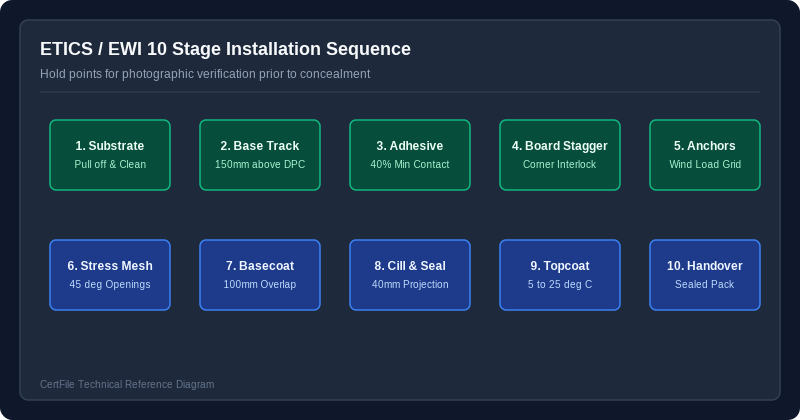
Quality management under NSAI Agrément surveillance audits requires that every concealed stage of an External Thermal Insulation Composite System (ETICS) is documented prior to coverage. Under EAD 040083-00-0404 and BS EN 13499 or BS EN 13500 frameworks, system durability depends directly on verified substrate readiness, continuous adhesive contact, accurate mechanical anchoring, and watertight perimeter detailing. Site supervisors should never authorise basecoat or render application until photographic hold points have been reviewed and signed off by the lead applicator.
Across Irish and UK retrofit programmes, including SEAI Domestic Technical Standards and Specifications (DTSS) and PAS 2030/2035 frameworks, retrospective inspection cannot verify hidden layers such as starter rail seals, adhesive dab percentages, or anchor embedment depths. Recording geolocated and time stamped evidence as work progresses creates an indisputable technical audit trail that protects the installer against unmerited warranty callbacks and audit rejections.
Site Supervision, Compliance Verification, and Long Term Warranty Protection
Delivering consistent quality across External Thermal Insulation Composite System (ETICS) contracts requires disciplined site supervision at every critical hold point. Under the NSAI Agrément surveillance scheme and the SEAI Domestic Technical Standards and Specifications (DTSS), contractors carry direct responsibility for proving that concealed components were installed strictly in accordance with the system holder technical manual and published certificate limits. Verbal assurances or unindexed smartphone photos are insufficient when resolving post completion disputes or passing independent technical audits.
Every project site should operate a clear inspection protocol led by a competent site supervisor or lead applicator. Before progressing from substrate preparation to base rail installation, from board fixing to mechanical anchoring, or from basecoat reinforcement to decorative topcoat, the supervisor must inspect the completed work against manufacturer tolerances and record verifiable evidence. Recording batch numbers from adhesive bags, basecoat drums, mesh rolls, and finish buckets ensures complete product traceability back to the approved distributor.
In addition to photographic documentation, contractors should maintain daily environmental logs noting ambient air temperature, wall surface temperature, and relative humidity at application time. Cementitious adhesives and polymer modified renders cure predictably only within specified climatic windows, typically between 5 degrees Celsius and 25 degrees Celsius per manufacturer data sheets. Documenting weather compliance protects the installer if sudden overnight frost or unexpected wind driven rain affects uncured finishes.
Finally, compiling all stage photographs, pull off test records, operative digital sign offs, and maintenance instructions into a structured, tamper evident handover pack gives both the building owner and the installer permanent peace of mind. A transparent ten year audit folder demonstrates professional craftsmanship, accelerates grant payment drawdowns, and protects your contracting business against unmerited warranty claims.
Regulatory Audit Trail and Handover Evidence Standards
Across both Ireland and the United Kingdom, external wall insulation and insulated concrete formwork contractors operate under strict third party inspection frameworks. In Ireland, NSAI Agrément ETICS schemes and SEAI Domestic Technical Standards and Specifications (DTSS) require registered contractors to retain project specific technical dossiers for ten years following completion. In the UK, PAS 2030, PAS 2035, and TrustMark lodgement frameworks impose equally rigorous photographic stage requirements prior to issuing 25 year guarantees.
Because critical structural and weatherproofing elements such as substrate pull off test interfaces, starter track DPC clearances, adhesive contact percentages, mechanical anchor embedment depths, and reinforcement mesh overlaps are permanently concealed behind topcoat render, retrospective visual inspection cannot prove compliance. When installers omit contemporaneous stage photos, any future audit query or warranty dispute places the burden of proof entirely on the contracting firm.
CertFile and the installer build the technical compliance file together directly on site. Field operatives follow structured hold point checklists on iOS or Android devices even without cellular signal, capturing geolocated, time stamped photographs alongside measured test values and digital biometric sign offs. Once works finish, CertFile compiles the entire audit trail into a cryptographically sealed PDF with QR verification, protecting the contractor and delivering complete transparency to BER assessors, Retrofit Coordinators, and building owners.
Related Installer Resources
Frequently Asked Questions
What is the minimum temperature for applying EWI basecoat and render?
Standard manufacturer data sheets and NSAI Agrément certificates (such as Soltherm 12/0371 and Baumit 10/0347) specify a minimum air and substrate temperature of +5 degrees Celsius during application and for at least 24 to 48 hours of curing.
What happens if frost hits wet EWI basecoat overnight?
Water inside fresh cementitious mortar freezes and expands, destroying hydration bonds and turning the cured basecoat soft, powdery, and delaminated.
Why does high humidity delay silicone topcoat drying?
Organic dispersion renders cure by water evaporation. Above 85 percent relative humidity, moisture cannot evaporate into saturated air, leaving the coat soft and vulnerable to rain washout.
Should installers add antifreeze to EWI adhesive?
Never add unapproved site admixtures or salt based antifreeze to proprietary EWI mortars. Only use factory formulated winter grade products specifically approved by the system holder.
Build Audit Ready Evidence with Your Site Team
Record stage photos, pull off test logs, and operative sign offs offline on site, and compile complete handover packs automatically.