Why EWI Warranty Claims Get Refused and What Proves Compliance
A ten year manufacturer material warranty or 25 year UK SWIGA guarantee is never unconditional. Every policy document stipulates that coverage applies only where the system was installed strictly in accordance with the published NSAI Agrément, BBA, or ETA certificate by competent trained operatives using approved single source components.
When a facade develops staining, localised blistering, or wind delamination five years after completion, loss adjusters investigate immediately for installation shortcuts. Without contemporaneous site records, the contracting business bears the entire cost of remedial scaffolding and re rendering.
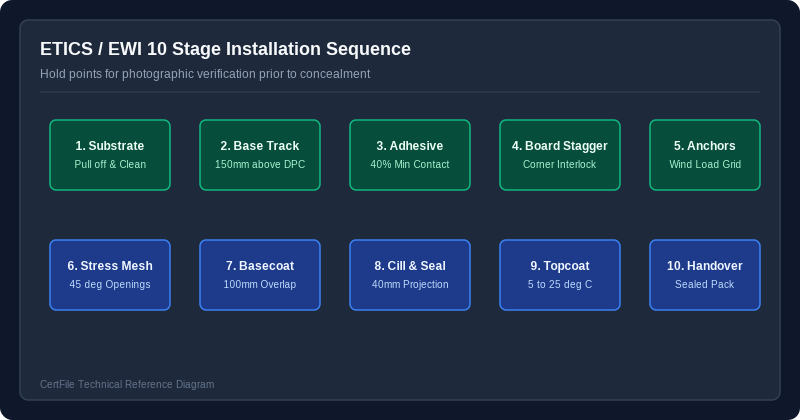
Step by Step Site Execution Sequence
- 1
Prove Single Source System Integrity
Log delivery dockets and container batch labels for adhesive, insulation, anchors, basecoat, mesh, primer, and topcoat to demonstrate zero unapproved generic substitutions.
- 2
Archive Substrate Pull Off Test Records
Keep calibrated tensile bond test logs showing cohesive substrate strength met or exceeded system minimums prior to adhesive installation.
- 3
Retain Concealed Stage Photographs
Archive GPS and time stamped photos of starter track DPC clearance, 40 percent adhesive spread, board stagger, L shaped opening cuts, and mechanical fixing grids.
- 4
Document Environmental and Curing Conditions
Keep daily temperature and relative humidity records confirming basecoat and topcoat were applied within manufacturer climatic limits.
- 5
Prove Maintenance Manual Delivery at Handover
Every NSAI Agrément certificate requires the installer to supply the homeowner with a maintenance guide. Retain signed proof of delivery so homeowner neglect (such as pressure washing or unsealed drill holes) cannot be blamed on installation.
- 6
Seal the Audit Pack Cryptographically
Compile all site evidence into an immutable PDF with QR verification so third party insurers and surveyors trust the record immediately.
What to Record on Site
CertFile and the installer build the technical file together. Capture these mandatory evidence items before subsequent layers conceal the work.
Required Photos
- Material pallet delivery photos showing batch numbers and brand packaging
- All 10 installation stages captured before concealment
- Pre existing wall defects (such as defective roof gutters or rising damp) prior to works
- Completed perimeter sealing and sill overhangs at handover
Readings and Logs
- Substrate pull off test results (kN and N/mm2)
- Daily air temperature and humidity readings during wet coat applications
- System Agrément certificate number and installer accreditation ID
Operative Sign Offs
- Operative biometric or digital stage sign offs
- Homeowner signed acknowledgement of maintenance obligations
How Homeowner Alterations Void Warranties Without Proof
Years after completion, homeowners often drill through rendered facades to mount satellite dishes, garden hose reels, pergolas, or security cameras without sealing the penetrations, or blast render with high pressure domestic washers. When water enters through those unsealed holes and causes frost spalling, homeowners frequently claim faulty workmanship.
A clean handover pack containing post completion panoramic photos (showing an undamaged facade with zero unapproved penetrations) plus documented proof that the maintenance manual was issued shifts liability squarely back to the unauthorised alteration.
Quality management under NSAI Agrément surveillance audits requires that every concealed stage of an External Thermal Insulation Composite System (ETICS) is documented prior to coverage. Under EAD 040083-00-0404 and BS EN 13499 or BS EN 13500 frameworks, system durability depends directly on verified substrate readiness, continuous adhesive contact, accurate mechanical anchoring, and watertight perimeter detailing. Site supervisors should never authorise basecoat or render application until photographic hold points have been reviewed and signed off by the lead applicator.
Across Irish and UK retrofit programmes, including SEAI Domestic Technical Standards and Specifications (DTSS) and PAS 2030/2035 frameworks, retrospective inspection cannot verify hidden layers such as starter rail seals, adhesive dab percentages, or anchor embedment depths. Recording geolocated and time stamped evidence as work progresses creates an indisputable technical audit trail that protects the installer against unmerited warranty callbacks and audit rejections.
Site Supervision, Compliance Verification, and Long Term Warranty Protection
Delivering consistent quality across External Thermal Insulation Composite System (ETICS) contracts requires disciplined site supervision at every critical hold point. Under the NSAI Agrément surveillance scheme and the SEAI Domestic Technical Standards and Specifications (DTSS), contractors carry direct responsibility for proving that concealed components were installed strictly in accordance with the system holder technical manual and published certificate limits. Verbal assurances or unindexed smartphone photos are insufficient when resolving post completion disputes or passing independent technical audits.
Every project site should operate a clear inspection protocol led by a competent site supervisor or lead applicator. Before progressing from substrate preparation to base rail installation, from board fixing to mechanical anchoring, or from basecoat reinforcement to decorative topcoat, the supervisor must inspect the completed work against manufacturer tolerances and record verifiable evidence. Recording batch numbers from adhesive bags, basecoat drums, mesh rolls, and finish buckets ensures complete product traceability back to the approved distributor.
In addition to photographic documentation, contractors should maintain daily environmental logs noting ambient air temperature, wall surface temperature, and relative humidity at application time. Cementitious adhesives and polymer modified renders cure predictably only within specified climatic windows, typically between 5 degrees Celsius and 25 degrees Celsius per manufacturer data sheets. Documenting weather compliance protects the installer if sudden overnight frost or unexpected wind driven rain affects uncured finishes.
Finally, compiling all stage photographs, pull off test records, operative digital sign offs, and maintenance instructions into a structured, tamper evident handover pack gives both the building owner and the installer permanent peace of mind. A transparent ten year audit folder demonstrates professional craftsmanship, accelerates grant payment drawdowns, and protects your contracting business against unmerited warranty claims.
Regulatory Audit Trail and Handover Evidence Standards
Across both Ireland and the United Kingdom, external wall insulation and insulated concrete formwork contractors operate under strict third party inspection frameworks. In Ireland, NSAI Agrément ETICS schemes and SEAI Domestic Technical Standards and Specifications (DTSS) require registered contractors to retain project specific technical dossiers for ten years following completion. In the UK, PAS 2030, PAS 2035, and TrustMark lodgement frameworks impose equally rigorous photographic stage requirements prior to issuing 25 year guarantees.
Because critical structural and weatherproofing elements such as substrate pull off test interfaces, starter track DPC clearances, adhesive contact percentages, mechanical anchor embedment depths, and reinforcement mesh overlaps are permanently concealed behind topcoat render, retrospective visual inspection cannot prove compliance. When installers omit contemporaneous stage photos, any future audit query or warranty dispute places the burden of proof entirely on the contracting firm.
CertFile and the installer build the technical compliance file together directly on site. Field operatives follow structured hold point checklists on iOS or Android devices even without cellular signal, capturing geolocated, time stamped photographs alongside measured test values and digital biometric sign offs. Once works finish, CertFile compiles the entire audit trail into a cryptographically sealed PDF with QR verification, protecting the contractor and delivering complete transparency to BER assessors, Retrofit Coordinators, and building owners.
Related Installer Resources
Frequently Asked Questions
What is the most common reason EWI manufacturers refuse warranty claims?
Manufacturers most commonly void warranties when installers substitute cheaper generic mesh, adhesive, or primer from another brand instead of installing a tested single source system.
How long must an EWI contractor keep site records?
NSAI Agrément registration schemes require certified installers to retain complete project audit folders for at least 10 years, matching standard warranty durations.
Does pressure washing void an EWI render warranty?
Yes. High pressure jet washing forces water through thin decorative coats and damages aggregate texture. Maintenance manuals specify low pressure soft washing only.
How does CertFile protect installers against false warranty disputes?
CertFile timestamps, geotags, and cryptographically seals every stage photo, test log, and handover receipt into an unalterable audit pack verifiable by QR code.
Build Audit Ready Evidence with Your Site Team
Record stage photos, pull off test logs, and operative sign offs offline on site, and compile complete handover packs automatically.