EPS vs Mineral Wool EWI: Installer Specification Guide
Specifying the correct core insulation material is one of the earliest and most consequential decisions an external wall insulation contractor makes on any retrofit project. While white and graphite Expanded Polystyrene (EPS) slabs account for the majority of standard two storey Irish housing retrofits, Mineral Wool boards are mandatory across higher risk buildings, party wall zones, and breathable solid masonry structures.
Misapplying EPS above statutory fire height limits or failing to adjust mechanical anchor counts for heavier mineral wool boards creates serious regulatory liabilities. Installers must understand the structural, hygrothermal, and commercial trade offs between BS EN 13499 (EPS) and BS EN 13500 (Mineral Wool) systems.
Step by Step Site Execution Sequence
- 1
Verify Building Height and Fire Class Regulations
Check Building Regulations Technical Guidance Document Part B (Ireland) or Approved Document B (UK) regarding building height thresholds. Buildings exceeding statutory height limits (typically 18 metres or relevant sleeping accommodation criteria [CONFIRM]) require non combustible Euroclass A1 or A2-s1,d0 mineral wool insulation.
- 2
Assess Existing Wall Breathability and Moisture Risk
Evaluate whether the building features traditional solid stone, lime mortar, or single leaf brick lacking a cavity. Mineral wool provides significantly lower vapour resistance (mu value around 1) compared to EPS, permitting moisture vapour diffusion.
- 3
Compare System Thermal Conductivity and Thickness
Graphite enhanced EPS typically offers lower thermal conductivity (around 0.031 W/mK) than standard mineral wool (around 0.036 W/mK), meaning mineral wool requires a slightly thicker slab to achieve the same target wall U value.
- 4
Account for Slab Weight and Mechanical Anchors
Mineral wool slabs are substantially heavier than EPS and require steel pinned mechanical anchors rather than purely plastic pins, alongside higher fixing density and closer starter track anchor spacing.
- 5
Adjust Handling, Cutting, and Basecoat Preparation
EPS slabs rasp flat quickly using abrasive boards, whereas dual density mineral wool slabs require clean saw cutting and a wet skim pre coat ("priming scrape") of basecoat to ensure full mechanical key prior to embedding mesh.
- 6
Document System Certificate Compliance
Verify that every adhesive, anchor, and finish coat matches the specific NSAI Agrément certificate for either EPS or Mineral Wool, as adhesive formulations and basecoat weights often differ.
What to Record on Site
CertFile and the installer build the technical file together. Capture these mandatory evidence items before subsequent layers conceal the work.
Required Photos
- Product packaging labels showing BS EN 13163 (EPS) or BS EN 13162 (Mineral Wool) standard
- Pre coat skim application on mineral wool boards prior to mesh embedding
- Steel pin mechanical anchors installed through mineral wool slabs
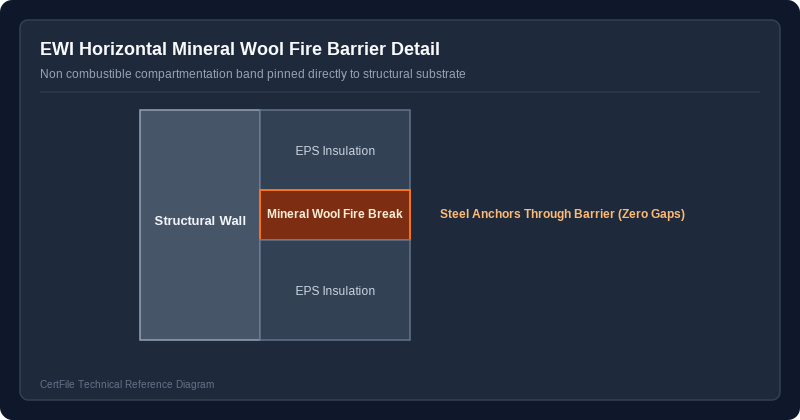
- Non combustible fire barrier strips if hybrid EPS system is installed
Readings and Logs
- Declared insulation thickness (mm) and thermal conductivity (lambda)
- Euroclass fire reaction classification per system certificate
- Anchor specification (steel pin vs plastic pin) and density per m2
Operative Sign Offs
- Specification verification confirming insulation type matches BER and fire design
- Supervisor inspection of mineral wool joint tightness prior to basecoat
Installer Productivity, Site Handling, and Commercial Factors
From an operational standpoint, EPS boards weigh only a fraction of high density mineral wool lamellas or dual density slabs. A single operative can carry, cut, and fix EPS substantially faster on scaffolding, and minor alignment steps rasp flat easily before basecoating. Mineral wool generates airborne fibres requiring PPE, demands specialist band saws or tungsten knives for clean cuts, and requires heavier scaffolding loads.
Material and labour expense per square metre for mineral wool systems is notably higher than EPS systems. Installers pricing tenders must factor in the extra steel anchors, increased basecoat consumption over fibrous surfaces, and slower daily output rates when quoting mineral wool specifications.
Quality management under NSAI Agrément surveillance audits requires that every concealed stage of an External Thermal Insulation Composite System (ETICS) is documented prior to coverage. Under EAD 040083-00-0404 and BS EN 13499 or BS EN 13500 frameworks, system durability depends directly on verified substrate readiness, continuous adhesive contact, accurate mechanical anchoring, and watertight perimeter detailing. Site supervisors should never authorise basecoat or render application until photographic hold points have been reviewed and signed off by the lead applicator.
Across Irish and UK retrofit programmes, including SEAI Domestic Technical Standards and Specifications (DTSS) and PAS 2030/2035 frameworks, retrospective inspection cannot verify hidden layers such as starter rail seals, adhesive dab percentages, or anchor embedment depths. Recording geolocated and time stamped evidence as work progresses creates an indisputable technical audit trail that protects the installer against unmerited warranty callbacks and audit rejections.
Site Supervision, Compliance Verification, and Long Term Warranty Protection
Delivering consistent quality across External Thermal Insulation Composite System (ETICS) contracts requires disciplined site supervision at every critical hold point. Under the NSAI Agrément surveillance scheme and the SEAI Domestic Technical Standards and Specifications (DTSS), contractors carry direct responsibility for proving that concealed components were installed strictly in accordance with the system holder technical manual and published certificate limits. Verbal assurances or unindexed smartphone photos are insufficient when resolving post completion disputes or passing independent technical audits.
Every project site should operate a clear inspection protocol led by a competent site supervisor or lead applicator. Before progressing from substrate preparation to base rail installation, from board fixing to mechanical anchoring, or from basecoat reinforcement to decorative topcoat, the supervisor must inspect the completed work against manufacturer tolerances and record verifiable evidence. Recording batch numbers from adhesive bags, basecoat drums, mesh rolls, and finish buckets ensures complete product traceability back to the approved distributor.
In addition to photographic documentation, contractors should maintain daily environmental logs noting ambient air temperature, wall surface temperature, and relative humidity at application time. Cementitious adhesives and polymer modified renders cure predictably only within specified climatic windows, typically between 5 degrees Celsius and 25 degrees Celsius per manufacturer data sheets. Documenting weather compliance protects the installer if sudden overnight frost or unexpected wind driven rain affects uncured finishes.
Finally, compiling all stage photographs, pull off test records, operative digital sign offs, and maintenance instructions into a structured, tamper evident handover pack gives both the building owner and the installer permanent peace of mind. A transparent ten year audit folder demonstrates professional craftsmanship, accelerates grant payment drawdowns, and protects your contracting business against unmerited warranty claims.
Regulatory Audit Trail and Handover Evidence Standards
Across both Ireland and the United Kingdom, external wall insulation and insulated concrete formwork contractors operate under strict third party inspection frameworks. In Ireland, NSAI Agrément ETICS schemes and SEAI Domestic Technical Standards and Specifications (DTSS) require registered contractors to retain project specific technical dossiers for ten years following completion. In the UK, PAS 2030, PAS 2035, and TrustMark lodgement frameworks impose equally rigorous photographic stage requirements prior to issuing 25 year guarantees.
Because critical structural and weatherproofing elements such as substrate pull off test interfaces, starter track DPC clearances, adhesive contact percentages, mechanical anchor embedment depths, and reinforcement mesh overlaps are permanently concealed behind topcoat render, retrospective visual inspection cannot prove compliance. When installers omit contemporaneous stage photos, any future audit query or warranty dispute places the burden of proof entirely on the contracting firm.
CertFile and the installer build the technical compliance file together directly on site. Field operatives follow structured hold point checklists on iOS or Android devices even without cellular signal, capturing geolocated, time stamped photographs alongside measured test values and digital biometric sign offs. Once works finish, CertFile compiles the entire audit trail into a cryptographically sealed PDF with QR verification, protecting the contractor and delivering complete transparency to BER assessors, Retrofit Coordinators, and building owners.
Related Installer Resources
Frequently Asked Questions
Which EWI insulation is better for fire safety?
Mineral wool (stone wool) is classified as non combustible Euroclass A1, making it the required choice for high rise buildings, fire barrier bands, and high risk facades.
Does graphite EPS achieve better U values than mineral wool at equal thickness?
Yes. Graphite enhanced EPS typically has a lower thermal conductivity (lambda around 0.031 W/mK) than mineral wool (around 0.036 W/mK), achieving target U values with a thinner wall build up.
Why must mineral wool EWI use steel pin anchors?
Under fire conditions, plastic pin anchors can melt and release heavy mineral wool slabs. Steel pinned mechanical anchors maintain structural retention under high temperatures.
Is mineral wool more breathable than EPS?
Yes. Mineral wool has an open fibrous structure with very low water vapour resistance, making it ideal for solid stone or historic masonry walls requiring vapour permeability.
Build Audit Ready Evidence with Your Site Team
Record stage photos, pull off test logs, and operative sign offs offline on site, and compile complete handover packs automatically.